The Second Mile

“If anyone forces you to go one mile, go with them two miles.” – Matthew 5:41

There is some important historical context here worth knowing.

Under Roman law, a soldier could compel any Jewish civilian to carry his gear for one mile. One mile was the legal limit. It was an obligation you could not refuse, and it was humiliating. You did not choose it. You were commanded.

Jesus told His followers to go two.

Not because they were required to. Not because it would earn them favor with Rome. But because the posture of a kingdom citizen is not to do the minimum. It is to exceed it. Freely. Willingly. Without resentment.

That is a counter-cultural idea in any era. And in ours, it is almost strange.

We are trained by the world to negotiate our obligations down. To do what is required and protect our time, our energy, and our effort from going any further than they have to. Minimum viable effort is a real philosophy people apply not just to work but to marriage, to parenting, to friendship, to faith.

Jesus said go two miles.

I want to talk to you about what this looks like in real life, because I think it shows up in the ordinary moments more than the dramatic ones.

It looks like the employee who stays an extra thirty minutes not because someone is watching but because the work is not finished. It looks like the husband who does the thing his wife asked without being asked twice. It looks like the dad who gets off the couch when he is tired because his kid needs five more minutes of his attention. It looks like the man who volunteers for the hard job, not the comfortable one.

It is not glamorous. The second mile rarely is. Nobody throws a parade for the man who consistently goes a little further than expected. But over years and decades, that habit builds something. It builds a reputation, a character, and a life that stands apart.

Colossians 3:23 is one of my favorite verses and I come back to it constantly – “Whatever you do, work at it with all your heart, as working for the Lord, not for human masters.” When you reframe your effort as worship, the second mile stops feeling like a burden. It becomes an offering. You are not going the extra mile for your boss or for your client or even for your family. You are doing it for God. And He sees every step.

Galatians 6:9 says, “Let us not become weary in doing good, for at the proper time we will reap a harvest if we do not give up.” The second mile is a long-game investment. You may not see the return immediately. But you will reap what you sow. God does not miss the faithful effort of a man who keeps showing up and keeps going further than required.

And Proverbs 22:29 asks, “Do you see someone skilled in their work? They will serve before kings; they will not serve before officials of low rank.” Excellence has a way of elevating you. Not because you were chasing elevation, but because diligence and excellence get noticed. By people. And by God.

I want you to be the men that people point to and say, “He always gives more than you expect.” At work. At home. In friendships. In faith.

Don’t negotiate your effort down. Don’t do the minimum and call it enough. Pick up the bag and keep walking past the mile marker.

The second mile is where character is built. And the men who walk it consistently are the ones who build lives worth pointing to.

Challenge this week: Find one place this week where you would normally stop at the first mile. Go the second. Don’t announce it. Just do it.

Your Yes Means Yes

“All you need to say is simply ‘Yes’ or ‘No’; anything beyond this comes from the evil one.” – Matthew 5:37

Jesus said this to a culture that had built an elaborate system of oath-making. There were oaths that were binding and oaths that were not. There were loopholes and technicalities and ways to make a promise that was not really a promise. People had gotten so creative with their commitments that you never really knew whether a man meant what he said.

Jesus cut through all of it with one sentence. Just say yes or no and mean it.

That was radical then. It is somehow even more radical now.

We live in a world of fine print. Contracts with exceptions. Commitments with exit clauses. Relationships with conditions buried in the small text. We have normalized a version of integrity where keeping your word only applies when it’s convenient, when no better option has appeared, and when there’s a consequence for walking away.

But a man of God is supposed to be different.

Your word should be a closed transaction. When you say you are going to do something, it is done. When you make a commitment, it is kept. When you say yes, you mean yes. When you say no, you mean no. No follow-up oath required. No loophole needed. Just your word – and the reputation you have built for being a man who keeps it.

I have tried to build that reputation over my lifetime. Not perfectly. I have fallen short. But it has always mattered deeply to me that the people who know me best know that when I say something, I mean it. That if I tell you I will be there, I will be there. That if I make a commitment, I honor it even when honoring it costs me something.

Because here is the truth – your integrity is always tested most when keeping your word becomes inconvenient. That is when the real you shows up. Anyone can keep a commitment when it is easy. The man of God keeps it when it is hard.

Luke 16:10 says, “Whoever can be trusted with very little can also be trusted with much, and whoever is dishonest with very little will also be dishonest with much.” Faithfulness in small things is how you build a life that God can trust with big things. It starts with your word on ordinary Tuesdays, not just in the big moments.

Proverbs 10:9 says, “Whoever walks in integrity walks securely, but whoever takes crooked paths will be found out.” Security is not found in cleverness or flexibility. It is found in integrity. The man who says what he means and means what he says never has to remember what story he told. He just tells the truth and walks on.

James 5:12 echoes Jesus almost word for word – “Let your yes be yes and your no be no.” James had heard the sermon. He remembered it decades later. Because it mattered that much.

People are watching to see whether your word means anything. Your girlfriend/wife is watching. Your children will watch. Your coworkers will notice. And over time, the reputation you build will either open doors or close them. Not because of what you say about yourself, but because of whether you do what you said.

Be the man that people don’t have to follow up with. Be the man whose handshake is enough. Be the man whose yes means yes and whose no means no, and who never needs a contract to prove he meant it.

That is a rare man. Be that man.

Challenge this week: Think about a commitment you have made that you have been slow to follow through on. This week, follow through. Let your yes mean yes.

Don’t Lose Your Flavor

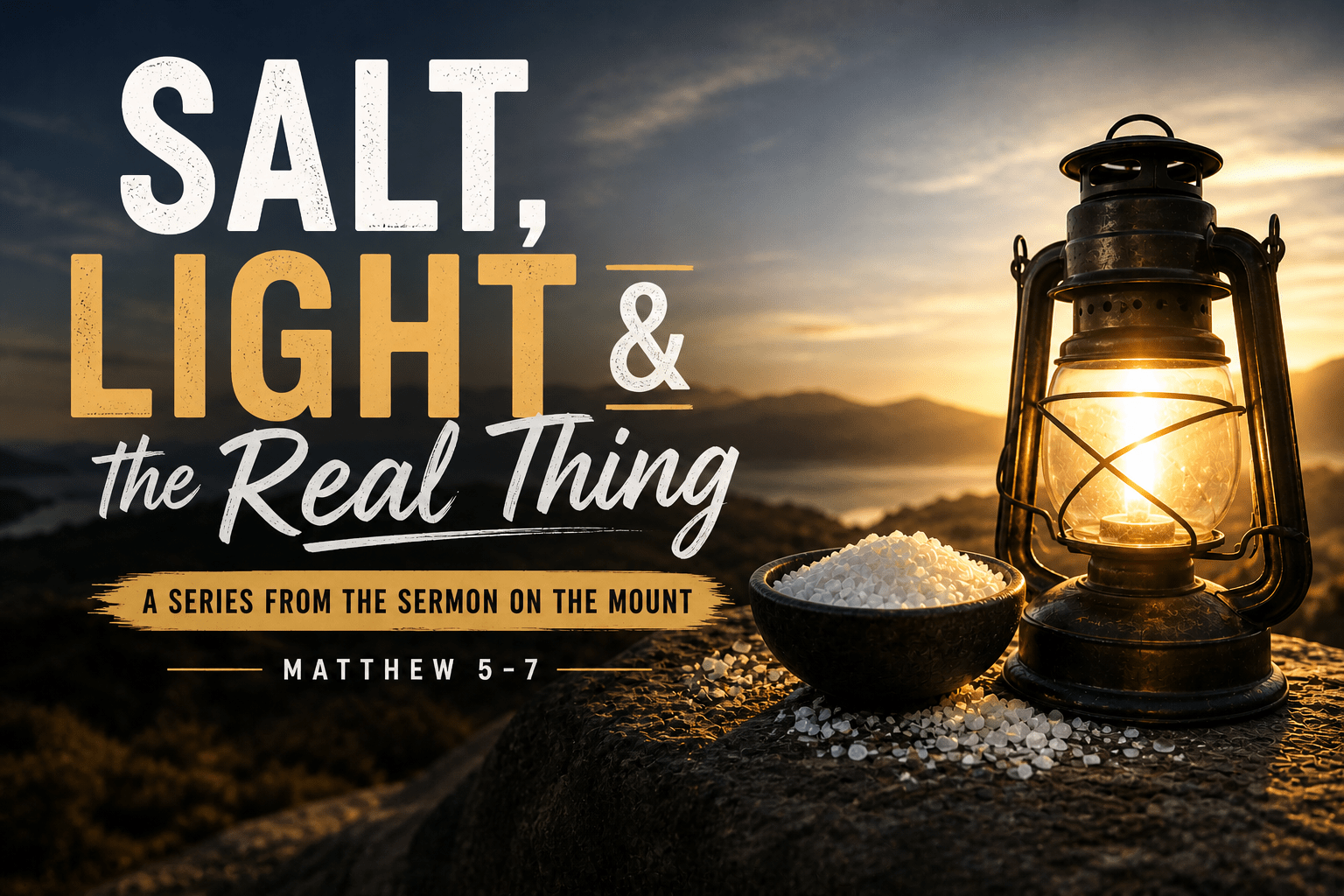
“You are the salt of the earth. But if the salt loses its saltiness, how can it be made salty again? It is no longer good for anything, except to be thrown out and trampled underfoot. You are the light of the world. A town built on a hill cannot be hidden.” Matthew 5:13-14

Salt has one job. And the moment it stops doing that job, it is worthless.

Not struggling. Not underperforming.

Worthless. Jesus chose that description on purpose.

I think about that a lot. Because one of the quietest and most dangerous things that can happen to a man of faith is not a dramatic fall into sin. It is a slow, comfortable slide into sameness. You don’t abandon your beliefs. You just stop letting them show up in the way you talk, the way you spend your money, the way you spend your time, the way you treat people when there is nothing to gain.

You blend in. And eventually, you can’t tell the difference between yourself and everyone else in the room.

That is what Jesus is warning against here. Not a dramatic backsliding. Just a man who loses his flavor.

In the ancient world, salt did two things. It preserved and it seasoned. It kept meat from rotting and it made bland things better. That is exactly what a man of God is supposed to do in the world around him. He slows the decay. He makes things better by being present. His integrity preserves his family. His honesty improves every conversation he walks into. His faith seasons every room he enters.

But that only works if the salt is still salty.

I will be honest with you. There have been times in my life where I was not much different from anyone around me. I went through the motions on Sunday and lived like everyone else Monday through Saturday. I wasn’t doing anything dramatically wrong. I was just doing nothing dramatically right either. I was present but flavorless. And looking back, I can see what I cost the people around me during those seasons. The influence I could have had. The words I could have spoken. The example I could have set.

You don’t get those times back.

Jesus also says you are the light of the world. A city on a hill cannot be hidden. He doesn’t say you should try to be visible. He says if you are truly walking with Christ, visibility is inevitable. Light doesn’t have to announce itself. It just removes darkness by being what it is.

The question is not whether people are watching. They are. Your kids are watching. Your coworkers are watching. Your neighbors are watching. The question is what they see when they do.

Paul put it plainly in Colossians 4:6 – “Let your conversation be always full of grace, seasoned with salt, so that you may know how to answer everyone.” Seasoned with salt. There it is again. Your words should have flavor. Your life should have flavor. Something should be different about the way you carry yourself.

And Romans 12:2 reminds us – “Do not conform to the pattern of this world, but be transformed by the renewing of your mind.” Conforming is easy. It requires nothing from you. Transformation is active. It is daily. It is choosing to let God shape you instead of letting the world shape you.

1 Peter 2:9 says you are “a chosen people, a royal priesthood, a holy nation, God’s special possession, that you may declare the praises of Him who called you out of darkness into His wonderful light.” You were called out of darkness for a reason. Not just to enjoy the light personally but to carry it somewhere.

The world does not need more men who are impressive on paper and flavorless in practice. It needs men who are the real thing. Men whose faith is not a category on a resume but a characteristic that people notice without you saying a word.

Don’t lose your flavor. The world needs what God put in you.

Challenge this week: Ask yourself honestly – is there anywhere in your life where you have started blending in? One conversation, one habit, one choice. Bring it back into alignment. Be salt. Be light. Be the real thing.

The Blessed Man – Peacemakers

“Blessed are the peacemakers, for they will be called children of God.” – Matthew 5:9

Peacemaking is not weakness. It is strength under control.

Jesus does not bless the peacekeepers – those who avoid tension at all costs. He blesses the peacemakers – those willing to step into tension to bring restoration. That is very different.

Peacemaking is not conflict avoidance. It is active reconciliation. It requires courage, humility, and maturity.

Most conflict lingers because both sides are waiting. Waiting for the other person to call. Waiting for the apology. Waiting for validation. Pride loves delay. Peacemakers refuse it.

In families, workplaces, and friendships, tension is inevitable. Misunderstandings happen. Words land wrong. Expectations go unmet. Silence grows.

It is easier to withdraw than to initiate healing. Easier to justify your position than to seek understanding. Easier to win an argument than to win a brother back.

I’ve seen relationships restored simply because one person chose to go first. One phone call. One honest conversation. One humble apology.

Peacemakers reflect the heart of Christ, who reconciled us to God. We did not move first. He did. Every time we pursue reconciliation, we mirror Him.

Peace is not pretending nothing happened. It is doing the hard work of repair so something better can grow.

Supporting Scripture

Romans 12:18 says, “If it is possible, as far as it depends on you, live at peace with everyone.”

And 2 Corinthians 5:18 reminds us we have been given “the ministry of reconciliation.”

Fatherly Guidance

Be the one who reaches out first.

Apologize even when you’re only five percent wrong.

Peace often costs pride.

Challenge This Week

Repair one strained relationship if possible.

The Blessed Man – Pure in Heart

“Blessed are the pure in heart, for they will see God.” – Matthew 5:8

When Jesus says “pure in heart,” He is not talking about spotless performance. He is talking about an undivided life.

The heart in Scripture is the control center – your thoughts, desires, motives, and affections. To be pure in heart means your inner world belongs fully to God. No double life. No hidden compartments. No carefully managed image.

Purity is not perfection. It is integrity. It is being the same person privately that you are publicly. A pure heart is undivided.

In the original language, the word for pure carries the idea of being clean, unmixed, without contamination. Think refined metal – heated until the impurities rise and are removed. That process is not comfortable. But it produces strength.

Temptation is real. Especially in a digital world where access is constant and secrecy is easy. The battle for purity today is not theoretical. It’s practical. It’s daily.

Purity is not maintained accidentally. It requires intentional guardrails.

There have been moments where compromise felt small at the time but created unnecessary distance between me and God. The damage wasn’t always public – but it was personal. And distance from God always costs more than we think.

Purity protects clarity. When your heart is clean, you see clearly – your purpose, your calling, and the presence of God.

Supporting Scripture

Psalm 24:3-4 asks, “Who may ascend the mountain of the Lord? … The one who has clean hands and a pure heart.”

And 1 Thessalonians 4:3 says plainly, “It is God’s will that you should be sanctified.”

Purity is not optional for spiritual strength.

Fatherly Guidance

Guard your inputs.

What you watch, entertain, and dwell on shapes your heart more than you think.

Integrity in private builds authority in public.

Challenge This Week

Identify one area where you need stronger boundaries and put them in place.

The Blessed Man – Merciful

“Blessed are the merciful, for they will be shown mercy.” – Matthew 5:7

Mercy is compassion in action. It is choosing forgiveness when offense feels justified.

It is remembering how much grace you’ve received before deciding how much to extend.  We forgive and have mercy because we were forgiven and given mercy. 

You will be misunderstood. Disrespected. Overlooked. Possibly betrayed. Nothing anyone has done to you trumps what the world did to Jesus. 

I have held onto frustration longer than I should have at times. It never made me stronger. It just made me heavier.

Mercy frees you more than it frees the other person.

Supporting Scripture

Ephesians 4:32 says, “Be kind and compassionate to one another, forgiving each other, just as in Christ God forgave you.”

And Micah 6:8 calls us to “act justly and to love mercy.”

Not tolerate mercy. Love it.

Fatherly Guidance

Keep short accounts.

Forgive quickly. Don’t let resentment quietly define you. Mercy protects your heart from becoming hard.

Grace is to give someone what they do not deserve. Mercy is not giving someone what they do deserve.

The man who extends grace and mercy reflects Christ more than the man who demands justice for every offense.

Challenge This Week

If there is someone you need to forgive, begin that process. Even if it’s just in prayer.

The Blessed Man – Those Who Hunger and Thirst for Righteousness

“Blessed are those who hunger and thirst for righteousness, for they will be filled.” – Matthew 5:6

Hunger and thirst are not casual interests. They are cravings. Jesus is describing a deep desire – not for status, wealth, or recognition – but for righteousness. For alignment with God. For integrity.

What you crave shapes what you chase.

Especially in young men, ambition is strong. That’s not wrong. But ambition without spiritual hunger becomes self-centered. There were times where I was more driven to succeed professionally than to grow spiritually. Success came, but it never satisfied.

Striving for righteousness fills in a way achievement never can.

Supporting Scripture

Psalm 42:1 says, “As the deer pants for streams of water, so my soul pants for you, my God.”

And Matthew 6:33 reminds us to “seek first his kingdom and his righteousness.”

Priority determines fulfillment.

Fatherly Guidance

Feed what you want to grow.

If you want hunger for God, you have to give it attention. Time in Scripture. Time in prayer. Time in obedience. Desire follows discipline more often than we realize.

Challenge This Week

Evaluate your schedule. Does it reflect hunger for God – or just hunger for progress?

Make one adjustment.

The Blessed Man – Meek

“Blessed are the meek, for they will inherit the earth.” – Matthew 5:5

Meekness is often misunderstood. It is not weakness. It is controlled strength.

A meek man has power but does not have to prove it. He has conviction but does not have to dominate every conversation. He is secure enough not to be defensive.

Meekness is strength under control.

In careers, competition is real. In marriage, ego can creep in. In leadership, authority can become identity. I’ve had moments when I pushed too hard just to prove a point. And even when I was technically right, I damaged relationships by how I handled it.

Meekness would have served me better. The world equates volume with authority. Jesus equates restraint with maturity.

Supporting Scripture

Proverbs 16:32 says, “Better a patient person than a warrior, one with self-control than one who takes a city.”

And Galatians 5:23 lists gentleness as a fruit of the Spirit. That means it is evidence of God’s work in you.

Fatherly Guidance

Don’t confuse aggression with strength. The strongest men in a room are often the calmest.

If you can win the argument but lose the relationship, choose the relationship. Self-control is a greater victory than dominance.

Challenge This Week

The next time you feel the urge to assert yourself, pause. Ask, “Is this about truth, or is this about ego?”

Choose restraint.

The Blessed Man – Those Who Mourn

“Blessed are those who mourn, for they will be comforted.” – Matthew 5:4

At first glance, this feels confusing. How can mourning possibly be connected to blessing?

Jesus is not glorifying sadness. He is describing a heart that feels the weight of sin – both personal and brokenness in the world. This kind of mourning is not despair. It is spiritual sensitivity.

To mourn is to refuse to become numb.

It is the ability to grieve what grieves God. It is the willingness to feel conviction instead of rationalizing compromise.

Young men are often taught to suppress emotion. “Be strong.” “Move on.” “Don’t dwell.” But strength in the kingdom is not emotional avoidance. It is emotional maturity.

There have been seasons in my life when I ignored conviction because it was uncomfortable. It’s easier to distract yourself than to sit with repentance. But the longer you avoid conviction, the harder your heart becomes.

Mourning over sin keeps your heart soft.

And a soft heart is easier for God to shape.

Supporting Scripture

Psalm 51:17 says, “A broken and contrite heart, O God, you will not despise.” God does not reject repentance. He responds to it.

And in 2 Corinthians 7:10, we’re told, “Godly sorrow brings repentance that leads to salvation and leaves no regret.”

There is a sorrow that crushes, and there is a sorrow that heals. Jesus is talking about the one that heals.

Fatherly Guidance

Do not run from conviction. Lean into it.

If the Spirit nudges you, pause. Confess quickly. Apologize quickly. Make things right quickly. The longer you delay, the more complicated things become.

I have learned that the fastest path back to peace is honest repentance.

Men who remain sensitive to God never drift too far.

Challenge This Week

Ask God to show you anything in your life that needs attention. If He highlights something, address it immediately.

Soft hearts stay close to Jesus.

The Blessed Man – Poor In Spirit

About this series: In a world that defines blessing by success, status, and self-sufficiency, Jesus offers a different vision. In the Sermon on the Mount, He describes the kind of man who is truly blessed – not by cultural standards, but by kingdom standards. This series walks verse by verse through the Beatitudes in Matthew 5, exploring what it means to live with humility, integrity, courage, mercy, and spiritual hunger. Written from a father’s perspective, these reflections are meant to encourage young men – and the dads guiding them – toward a steady, authentic walk with Christ.

“Blessed are the poor in spirit, for theirs is the kingdom of heaven.” – Matthew 5:3

It’s not accidental that this is the first statement Jesus makes in the Sermon on the Mount. Before He talks about mercy, purity, peacemaking, or endurance under persecution, He starts with posture.

“Poor in spirit” doesn’t mean insecure or passive. It doesn’t mean weak. It means spiritually aware. It means understanding that, on your own, you don’t have what it takes. It’s the recognition that strength, wisdom, and stability don’t originate within us – they are given to us.

To be poor in spirit is to live with a settled awareness that we are not self-made. We are God-sustained.

That humility is not weakness. It’s clarity.

For young men stepping into careers, marriage, leadership, and responsibility, there is a subtle temptation toward self-reliance. As skills grow and confidence increases, it becomes easy to drift from gratitude to ownership – from “God has blessed me” to “I’ve built this.”

That shift rarely feels dramatic. It just quietly hardens the heart.

But Jesus begins here for a reason. The kingdom belongs to those who know they need Him. The world rewards independence and self-sufficiency. Jesus blesses dependence.

Sometimes spiritual danger doesn’t come through failure. It comes through success that slowly convinces us we’re fine on our own.

Supporting Scripture

James 4:6 reminds us, “God opposes the proud but shows favor to the humble.” That is a sobering truth. Pride doesn’t just weaken us – it positions us against the very grace we need.

And in John 15:5, Jesus says, “Apart from Me you can do nothing.” Not “a little less.” Not “with slightly reduced impact.” Nothing eternal. Nothing that carries kingdom weight.

Fatherly Guidance

If there is one discipline that shapes a man’s life over decades, it is daily dependence on God.

Before leading others, lead your own heart into humility. Before making decisions, acknowledge your need for wisdom. When things are going well, intentionally lower yourself before the Lord rather than elevating yourself internally.

The strongest men are not the most self-assured. They are the most God-aware.

Real strength kneels first.

Challenge This Week

Start each day with a simple prayer before you reach for your phone:

“Lord, I need You today. Guard my heart from pride. Keep me dependent on You.”

That posture, practiced consistently, will shape a lifetime.